


When
you get right down to it, we drunkards are
a pretty easy-going bunch.
Our needs are not excessive. Give us a glass of whiskey and a comfy place
to drink it and we’re happy. Good drinks, good friends, good times—these
are keys to a good life. Every once in a while, though, teetotalers and bureaucrats
get it into their heads that we are easy to push around, or even worse, that
we are so inebriated so much of the time that we won’t notice when they
step on our toes. They hardly ever recall their anti-alcohol actions with fondness.
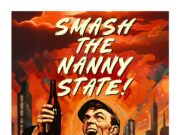
Case in point: The Whiskey Rebellion.
In 1791, Alexander Hamilton, Treasury Secretary for the
newly-minted United States of America, woke up one morning
with what he thought was a very good idea. The country was
in a small financial bind. Nothing major, but it could certainly
become so if the budget was suddenly faced with a major
expense, such as another war with the increasingly angry
Natives or another lengthy set-to with the still-smarting
Brits. A prudent man, Hamilton was loath to go any further
into debt to the French. He wanted a robust source of local
income—American money put to use defending American
interests. Which seems a perfectly swell idea, until you
discover that Hamilton thought to collect his loot by imposing
a huge tax on whiskey. Not on all intoxicating beverages,
mind you, just whiskey, the nation’s favorite drink,
bar none.
For Hamilton, taxing whiskey served multiple good purposes.
First, it would cement the needed defense monies, and second,
it would force his countrymen to drink something other than
whiskey, which he considered a blight on the nation’s
health and morals. Drinking wine and beer was fine by Hamilton.
He enjoyed both himself. Whiskey, on the other hand, made
people crazy and caused them to behave too much like Irishmen.
A heavy tax would deter such unseemly excesses.
Much to Hamilton’s chagrin, many people reacted badly
to the idea. Thomas Jefferson, who already thought Hamilton
was an ass, called the tax “infernal.” Other
people rightly pointed out that the country had only recently
finished a bloody war to extricate itself from the claws
of a government that had oppressively taxed its people without
their consent. Pennsylvania assemblyman Albert Gallatin
lambasted the proposal, saying it would put an undue burden
on farmers in his state, where, incidentally, an estimated
25 percent of all American stills were located.
Despite these voices of reason and outrage, the tax bill
wafted through Congress as easily as a leaf on a warm summer
breeze. At the beginning, the levy was set at seven-and-a-half
cents per gallon, but was quickly increased, first to nine
cents, then to 11 cents. Then, to make matters worse, an
additional yearly charge was leveled at farmers; sixty cents
for each gallon to the full capacity of his still. It didn’t
matter if the farmer distilled only five gallons of whiskey
from a ten-gallon-capacity still. He was taxed for all ten
gallons.
Needless to say, the nation’s farmers (who were also
the nation’s whiskey distillers) were outraged, and
none more so than the Pennsylvanians. The Pennsylvanians
went berserk.
With assistance from assemblyman Gallatin, an association
of Pennsylvanian farmers wrote to Congress, protesting the
ridiculous law:
[The law] appears unequal in its operation and immoral
in its effects. Unequal in its operation, as a duty laid
on the common drink of a nation, instead of taxing the citizens
in proportion to their property, falls as heavy on the poorest
class as on the rich; immoral in its effects, because the
amount of duty resting on the oath of the payer, offers,
at the expense of the honest part of the community, a premium
to perjury fraud.
One aspect of the law that particularly annoyed the protestors
was that it allowed tax collectors to “snoop in barns,
closets and cellars looking for hidden untaxed spirits.” The
potential was high for abuse by authorities in their zeal
to enforce the law. Plus, to allow such intrusions
upon a free person’s private land would be the same
as inviting the hated British back to run things.
Congress listened patiently to the complaints from Pennsylvania,
smiled benignly, and totally ignored them. The whiskey tax
became law.
Enforcing it became a whole other kettle of ale.
Federal tax collectors descended upon Pennsylvania like
a cloud of bugs. Right from the outset, though, local farmers
let it be known in no uncertain terms that the tax men were
not welcome, and if they chose to show up anyway they could
count on repercussions. The farmers meant it, too. Tax men
were routinely harassed. Angry whiskeymen attacked them
with pitchforks or lured them down lonely roads, where they
were waylaid and beaten bloody. If the revenue collectors
remained tenacious, midnight raiders would learn where they
lived and burn down their houses. But by far the most popular
way of dealing with unwelcome tax officials was to capture
them and spend a few free-wheeling hours having them tarred
and feathered. Oppressed farmers kept a ready supply of
both ingredients, and many revenuers stumbled home looking
more like poultry than men, and in a great deal of pain—ridding
one’s self of a coating of tar and feathers was both
excruciating and time-consuming. When finally cleansed of
their new plumage, victims looked as if they had been vigorously
boiled. These and numerous other tactics were used against
the odious tax collectors.
Back in Virginia, Alexander Hamilton was livid. He issued
decrees in which he demanded that the farmers obey the law,
cease terrorizing government inspectors, and pony up the
money they owed without further complaint. The farmers listened
and then, not to put too fine a point on it, told Hamilton
and his congressional cronies to go pound sand. To illustrate
their resolve, Pennsylvania whiskey makers formed themselves
into an army, some six thousand strong. They sent word to
Hamilton that they would sooner secede from the Union than
pay the hated tax.
President George Washington now found himself in a truly
rotten position. He wanted to uphold the law, no matter
how stupid he might have found it, but he was horrified
at the prospect of dispatching American soldiers to battle
American citizens. Eventually, in 1794, his envoys arrived
at a compromise with the Pennsylvania distillers. The tax
would be reduced to a tolerable level and, in return, Washington’s
army would depart. Additionally, anyone who had been arrested
for violating the law would receive a presidential pardon
and be allowed to return home.
Most distillers began paying the tax, but remained angry.
Some refused outright. The tax was unfair and oppressive,
facts that remained unchanged regardless of George Washington’s
involvement. Those who refused to pay, as well as their
children and grandchildren, invented methods of dodging
the tax that would remain useful right up until today. They
were America’s original moonshiners. Today, in dry
counties all over the south and west, right-thinking whiskeymen
continue to dodge the revenue man.
Our country almost had a civil war over whiskey. It’s
a worst-case scenario, but indicative of what you can expect
when you awaken the drunken giant.¸
—Richard English
(Note: the Author is indebted to the works of Eric
Burns, Mark Edward Lender & James Kirby Martin, and
Sharon V. Salinger.