



The
perennial comic strip “Andy Capp” has recently
been banished from the Washington Post as an evil influence,
and small wonder.
In
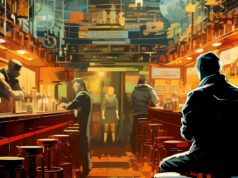
Andy’s world there are only three scene changes—his
pub, his living room, and the street in between. Sometimes
he tries to entice a lass at the bar. Sometimes he brings
his wife, to swap acid comments with the bartender. Sometimes
she awaits him at home, in curlers, with a rolling pin.
The story line has a mythic simplicity, the endlessly repeated
escapes to conviviality and returns to domesticity, Huck’s
world and Aunt Polly’s forever at cross-purposes.
Andy’s
English, so he gets away with it. If he were American,
he’d be guilty of abusing beer and punished with
professional counseling. Five or ten years ago, the authorities
in charge of our health were saying that a couple of drinks
a day were actually good for us, and fortified the heart
in the medical as well as the emotional sense. Now they’ve
changed their minds, as they often do. Having finished
establishing tobacco as the Grim Reaper and assuring the
populace that those who resist it will live, if not forever,
at least for a thousand years, they found themselves with
no rousing battle to fight, reduced to nattering about
fruits and vegetables. They dropped from the headlines
and the top of the news hour. Desperate, they pounced on
what they call “alcohol.”
(“A round of alcohol for the bar, Pete, and have one
yourself.”) Alcohol is our new killer. Even small
amounts of alcohol. Even the civilizing glass of wine and
the cold beer of a summer’s afternoon are as poisonous
as warm gin from the bottle.
Millions
believe them. But then, millions have been believing them
for decades, faithfully trotting after their twists and
turns. Millions even ate oat bran, a harmless abrasive
substance derived from boot scrapers, when told to do so.
Americans, when not at work or out jogging, are supposed
to stay home embracing family values, each encased in his
separate walls, and drink bottled water. The neighborhood
tavern languishes. After it closes down, it reopens as a
coffee shop, virtuous tavern-substitute of the century’s
end.
Coffee
shops are not the same. As a devoted fan of canned Maxwell
House, I don’t frequent them willingly, but I’ve
been dragged in by up-to-date friends who claim they can
distinguish among a dozen Colombian blends and sniff out
Ethiopian Yirgacheffe at twenty paces. In a coffee shop
there are tables where people sit drinking coffee and avoiding
eye contact with neighboring tables. Sometimes there’s
a counter where people hunch over their caffeine facing,
not a friendly barkeep and rows of gleaming bottles, but
a blank wall or a window onto traffic. For unknown reasons,
it would be as invasive to open conversation with one’s
neighbor here as it would be at a lunch counter. A counter
is not a bar.
The
company of one’s fellow creatures was always the
point of the public house. Samuel Johnson said the pub
was the throne of human felicity; E. B. White praised the “golden
companionship of the tavern.” The American decline
in public quaffing raises the disturbing question of why
we no longer seek out golden companionship except in the
sanitized, faceless privacy of the Internet.
Historically
the tavern’s enemies always ignored its social joys
and claimed it was merely a place to get drunk, an evil
snare wherein the once-decent family man destroyed his
health and drank up his loved ones’ grocery money.
But humans are nothing if not ingenious and when they wanted
to get pie-eyed they never really needed a tavern. Fermenting
and distilling are simple processes by which bulky crops
like apples, corn, and potatoes could be much reduced in
bulk, though not in value, and sold locally in barrels
or jugs instead of hauled to market in a cart. Before freezers,
before Mason jars, an oversupply of perishables could thus
be preserved indefinitely; a lady diarist traveling through
my own area of Virginia in 1755 was refreshed en route
with “peach whiskey.”
The
making of drinkable wine, ale, and beer was more laborious,
a job for professionals. For these, the citizen traditionally
repaired to bistro, trattoria, biergarten, taverna,
or corner pub to drink in company, perhaps to sing, play
darts or backgammon, and hear the news. Not Dan Rather’s
news but the important news—whose crops had been
flattened by hail, who got married, who got mugged, who
got fired, and how the man on the next barstool finally
had his old cat put down and can’t stop grieving.
Don’t
we care anymore?
In
the countryside, where the “ordinary house” was
often the second or third building constructed in a newly
forming town, it was blessed as a place to see people instead
of cows and chickens, and functioned as a clearinghouse
of information on swine fever, horse races, and grain prices.
In the bygone days of slow travel, taverns along the roads
provided sleeping quarters for man and horse, and here
the local folks went to hear news from the passerby, from
beyond the mountain, across the river; to see a gloriously
unfamiliar face and pick up new tales to tell. And always,
in cities, the corner tappie made a familiar safety zone
in the chaos and introduced neighbors who would never otherwise
meet.
Behind
the swinging doors in the wild old West, land of bachelors,
the saloon in Sagebrush City provided the only available
social life. Here, according to the movies, deals were
made, scores were settled, no-good women danced on the
bars, folks with aces concealed in their clothing were
shot dead, and from time to time splendid brawls broke
out, rich with crashing bottles, splintering mirrors, and
brandished barstools. In short, everything to brighten
the mind with memories during the lonely months on the
range or the homestead or, perhaps, in jail.
With
Prohibition the American tavern went underground, became
a speakeasy, and partook of some of the western tradition,
the spice of police raids and gangster shootouts flavoring
the bootleg hooch. After Prohibitions repeal, the tavern
lost its drama but regained its dignity as a haven—anchor
of neighborhoods and center of civic and political life.
Perhaps,
in hindsight, the end began back in the early 1950s when
television sets appeared behind the bar. They seemed like
a good idea at the time. They were rare in homes—many
sensible people didn’t even want them in
their homes—but from time to time events appeared
on them and extra customers flocked into the bar to watch
a heavyweight bout or an election. This rejoiced the hearts
of the management while secretly undermining its future.
Television
is noisy. It makes casual conversation an effort and confiding
in bartenders too loud to be confidential. Even with the
sound turned off, television is distracting. Images squirm
around on the screen. A row of people at a bar, confronted
by television, tend to ignore each other and stare at the
set. The whole purpose of the tavern fades: why be here
at all?
One
by one the customers bought their own televisions and realized
that, without fellowship, there wasn’t much point
in the pub, and they might as well save the money, buy
a six-pack, and sit home with their shoes off. There they
still sit.
In
the ‘70s, the Age of Sex, watering holes enjoyed
a renaissance, and people called “singles”
went to places called “singles bars” in search
of love. This was not the tavern-as-haven that we knew for
millennia but more like the tavern as shopping center; “golden
companionship” took on a different meaning. Then sex
as a hobby crashed almost overnight and the
‘70s were replaced by the ‘80s, by health and
fitness and the solitary joys of jogging and carrot juice
that still haunt us today. The bar was condemned anew as
a den of iniquity, black with the sins of alcohol and secondhand
smoke.
At
the dawn of the current decade I lived in the middle of
a city and rejoiced in a neighborhood tavern around the
corner, fallen on shabby days but still in business. The
television was consigned to the far end, beyond the bar,
and anyone determined to turn it on had to retreat back
there to the rickety table underneath it. Except in times
of national emergency nobody did.
To
this tavern repaired a goodly handful of local residents
on our evening routes between work and apartment. We had
little in common except this destination, but we accepted
each other without question. The bar is the essence of
democracy, the great leveler, literally as well as figuratively.
At a bar, everyone is the same size. Elsewhere some men
are taller than others and the discrepancy is of great concern
to them, odd as this seems to women. Standing at a cocktail
party, men must struggle with the responsibilities of tallness
or the humiliations of shortness; you can watch it from
a distance in their postures and the pitch of their voices.
Because height is largely a matter of legs, on barstools
they finally see eye to eye, equals.
Over
a period of several years we at the tavern grew to know
each other as well as we knew our immediate families. We
knew the names of each other’s bosses, landlords,
dogs, siblings. Hand in hand we passed through stormy love
affairs, a painful coming-out, career changes, surgery.
When Steve’s divorce was final he bought drinks for
the bar. When I had a new book out, so did I.
Except
for the chance street encounter we never saw each other
elsewhere, and this gave our friendships a luminous, self-contained
quality, limiting responsibility, enhancing pleasure. Unless
you count James, who wintered outside on the steam vent
and joined us only when driven by thirst, we weren’t
sad, mad loners; we all had jobs, families, social lives.
But we had this separate place too, this undemanding refuge
that was neither here nor there.
The
barkeeps, though moody, were always interesting people,
hand picked by the owner for compatibility rather than “mixology”;
indeed, they flatly refused any assignment more taxing
than a martini, which drove away suburbanites and the trendy.
The
perfect neighborhood tavern.
On
a Saturday afternoon my sister called me at home to say
that our mother had died, quite unexpectedly. I sat for
a long time staring at the telephone, wondering what to
do next. A dozen phone calls had to be made. Sympathy must
be extended and received. Responsibilities shouldered.
My office alerted, a suitcase packed, a train caught. Deep
in shock, I wasn’t ready for any of this.
I
put on my coat and walked around the corner.
It
was early and the bar was empty except for the bartender,
and he was a substitute. A stranger. I’d never seen
him before. Still he was a bartender, one of the last of
the dwindling breed of comforters, trusted instinctively.
I sat down at the end.
“What
can I do for you?”
he asked.
I
couldn’t remember what I usually drank. “I
don’t know,” I said stupidly. “My mother
just died.”
He
turned on his heel and walked up the length of the bar
to the trap door, came out and down the row of bar-stools
to mine. Silently he gave me an enormous, hard, smothering
hug, then went back behind the bar and poured me a double
whiskey on the house, set it in front of me, and left me
alone with it. Up at the far end he stood dunking glasses,
silent but available.
I
nursed my drink. Confusion smothered my mind and all I
knew, the one fact I could grasp, was that I was in the
right place. The only right place. Not yet surrounded by
family and friends, not still alone in my apartment staring
at the telephone, but here on this barstool.
The
last time I visited the city, the tavern was closed and
the building was for sale.
Where
will the regulars go when their mothers die?
—Barbara
Holland